
ACTIONS
- Protect and safeguard cultural and natural heritage
- Learning and educational opportunities
- Cultural participation/social inclusion
- Sustainable tourism
- Support research
- Employment (recruiting, training, safety)
- Energy consumption, greenhouse gas emissions
- Waste management and reduction
- Transport (forms of, energy use)
- Commercial activities including copyright and IP
- Governance and management
- Security, disaster preparedness, risk reduction
- External partnerships and collaborations
SDGs



- Sign-post to other resource (database)
- Case studies
- Virtual exhibition
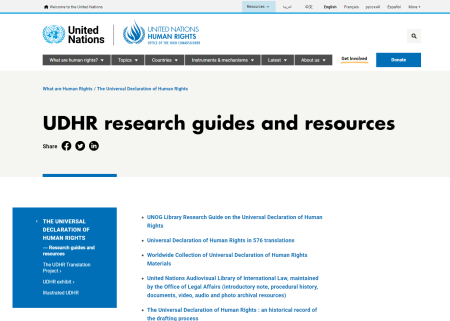
Universal Declaration of Human Rights Research Guides and Resources
Intended Audience
Anyone interested in human rights and the Universal Declaration
- United Nations Human Rights
A selection of resources to support education and awareness on the Universal Declaration of Human Rights
Avaiable in
- English
SDGs LINKAGES
The resource is most closely related to SDGs around education and policies for sustainable development, including 4.7 (Education for Sustainable Development), 4.A (effective learning environments), 10.2 (universal inclusion), 11.7 (safe and inclusive public spaces), 16.6 (effective, accountable and transparent institutions), 16.10 (fundamental freedoms) and 16.B (promote laws and policies for sustainable development).
Click on the SDG Target to discover Our Collections Matter indicators
-
Our Collections Matter indicators:
- Numbers of people in each type of programme drawing on collections from different demographic groups.
- Increases in numbers of people in each type of programme from different demographic groups.
- Proportion of people involved in such programmes in relation to overall audience size.
- Evidence that learners have acquired knowledge and skills to promote sustainable development.
-
Our Collections Matter indicators:
- Number and proportion of education facilities that are child, disability and gender sensitive.
- Proportion of education facilities that provide safe, non-violent, inclusive and effective learning environments for all.
- Number and type of initiatives to improve effectiveness of learning environments.
- Support given to other education facilities to make them more inclusive and effective.
-
Our Collections Matter indicators:
- Collections development to ensure that collections effectively meet the needs of all, irrespective of age, sex, disability, race, ethnicity, origin, religion or economic or other status.
- Number and proportion of educational and participatory programmes that promote participation irrespective of social or other status.
- Numbers and proportions of people making use of collections in relation to the demographic of the local population.
- Numbers and proportions of people involved in focused programmes aimed at promoting social, economic and political inclusion.
- Numbers and proportions of people from different demographic groups involved in decision-making processes relating to collections and collections-based institutions.
- Number and types of partnerships that build relationships with marginalized groups, individuals and communities.
-
Our Collections Matter indicators:
- Numbers of people accessing collecting institutions from different demographic groups, notably women, children, older people and persons with disabilities.
- Increases in numbers of people accessing collecting institutions from different demographic groups.
- Measures taken to remove barriers to access green and public spaces.
- Extent of green space provided by collections institutions.
-
Our Collections Matter indicators:
- Proportion of the population [audience/users/non-users] satisfied with their last experience of public services.
- Access to information, and accountability policies and mechanisms, in place.
- Effective institutional arrangements, both for own working and for working in partnership with other sectors, in place.
- Plans and arrangements in place for extraordinary circumstances such as natural and human-caused disasters.
- Effective arrangements in place to fulfil legal and social obligations and responsibilities.
- Effective arrangements in place for transparent communication and reporting of institutional performance.
- Effective arrangements in place for transparent decision-making and accountability.
-
Our Collections Matter indicators:
- Adopt and implement constitutional, statutory and/or policy guarantees for public access to information.
- Plans in place, and plans implemented to enhance public access to information relating to collections.
- Plans in place, and plans implemented to support fundamental freedoms, in line with human rights, national and international agreements and legislation.
- Plans and procedures in place for public access to information relating to the operation and management of collections-based institutions.
- Complaint mechanism in place for public to use where public access to information and fundamental freedoms not supported or fulfilled.
-
Our Collections Matter indicators:
- Proportion of population [audience/users/non-users] reporting having personally felt discriminated against or harassed in the previous 12 months on the basis of a ground of discrimination prohibited under international human rights law.
- Number and proportion of policies that incorporate sustainable development considerations, in the full sense of recognizing all three of social, economic and environmental considerations.