
ACTIONS
- Protect and safeguard cultural and natural heritage
- Learning and educational opportunities
- Cultural participation/social inclusion
- Sustainable tourism
- Support research
- Employment (recruiting, training, safety)
- Energy consumption, greenhouse gas emissions
- Waste management and reduction
- Transport (forms of, energy use)
- Commercial activities including copyright and IP
- Governance and management
- Security, disaster preparedness, risk reduction
- External partnerships and collaborations
SDGs



- Publication/report
- Toolkit/framework/roadmap
- Video
- Charter
- Factsheets
- Expert viewpoints
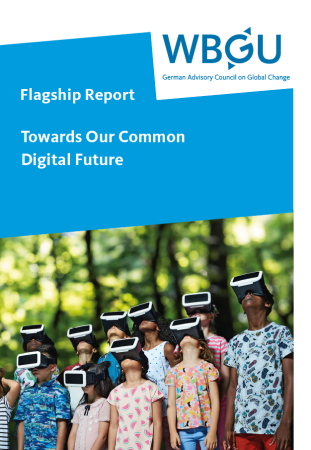
Towards Our Common Digital Future
- Digital policy makers and actors of all kinds
“In the report “Towards our common digital future”, the WBGU makes it clear that sustainability strategies and concepts need to be fundamentally further developed in the age of digitalization. Only if digital change and the Transformation towards Sustainability are synchronized can we succeed in advancing climate and Earth-system protection and in making social progress in human development. Without formative political action, digital change will further accelerate resource and energy consumption, and exacerbate damage to the environment and the climate. It is therefore an urgent political task to create the conditions needed to place digitalization at the service of sustainable development.”
Avaiable in
- English
- German
SDGs LINKAGES
The resource is extremely broad in considering how digitalization impacts on sustainable development, relating to, for example, education for sustainable development and access to information (4.7, 12.8, 13.3, 16.10), reducing the digital divide (unequal access and opportunity to use and benefit from digitalization) (1.4, 4.5, 5.1, 5.B, 9.C, 10.2, 11.B, 17.6), digitalization and heritage (11.4), supporting research for digitalization and vice versa (9.5), reducing the impact of digitalization on use of environmental resources (e.g. 12.6, 13.3), technology and infrastructure for wellbeing and sustainability (9.1), ensuring people’s use of digital resources protects their rights and is free from harm (e.g. 11.7, 16.10, 16.B), policy coherence (17.14), and how digitalization can promote solidarity and access to information (e.g. 17.16 and 17.17). The Charter and the set of recommendations in the report can be used as a template for these actions.
Click on the SDG Target to discover Our Collections Matter indicators
-
Our Collections Matter indicators:
- Numbers and proportions of people from particular groups using collections in comparison with demographics in broader society.
- Numbers of people accessing collections.
- Number of targeted programmes that aim to enhance access to collections by disadvantaged groups.
- Sustainable tourism that enhances local communities’ access to basic services, ownership and control over land and other forms of property (including cultural and natural heritage), as well as to technology and markets.
- Involvement of people from disadvantaged groups in decision-making activities and processes relating to collections and collections-based institutions.
-

Our Collections Matter indicators:
- Number of educational and/or training programmes drawing on collections directed to eliminate gender disparities in education.
- Number of educational and/or training programmes drawing on collections directed to meet the particular needs of persons with disabilities.
- Number of educational and/or training programmes drawing on collections directed to meet the particular needs of Indigenous peoples’ groups.
- Number of educational and/or training programmes drawing on collections directed to meet the particular needs of children in vulnerable situations.
-
Our Collections Matter indicators:
- Numbers of people in each type of programme drawing on collections from different demographic groups.
- Increases in numbers of people in each type of programme from different demographic groups.
- Proportion of people involved in such programmes in relation to overall audience size.
- Evidence that learners have acquired knowledge and skills to promote sustainable development.
-

Our Collections Matter indicators:
- Collections development to ensure that collections effectively meet the needs of all, irrespective of sex or gender.
- Number and proportion of educational and participatory programmes that promote participation irrespective of sex or gender.
- Numbers and proportions of girls, women and gender-diverse people making use of collections in relation to the demographic of the local population.
- Numbers and proportions of girls, women and gender-diverse people involved in focused programmes aimed at promoting social, economic and political inclusion.
- Numbers and proportions of girls, women and gender-diverse people from different demographic groups involved in decision-making processes relating to collections and collections-based institutions.
- Number and types of partnerships that build relationships with people of different sex and gender.
-
Our Collections Matter indicators:
- Number of programmes that support ICT skills, notably for girls and women.
-
Our Collections Matter indicators:
- Development of research-useful collections to support reliable, sustainable and resilient use by researchers and others.
- Number and proportion of collections facilities and stores that support economic development and human well-being.
- Number and proportion of collections facilities and stores that provide affordable and equitable access for all.
- Investment in collections facilities.
- Inclusion of collections information in regional and transborder initiatives, notably via digital access for discoverability.
-
Our Collections Matter indicators:
- Number and proportion of collections facilities that effectively support research and researchers.
- Number and proportion of staff who are appropriately skilled to undertake and support collections-based research.
- Expenditure on initiatives to enhance and upgrade collections facilities.
- Numbers of staff engaged in supporting and developing research use based on collections.
- Number of initiatives to encourage innovation drawing on collections.
- Increase in number of research and development workers per 1 million people.
- Increase in public and private research and development spending being used to develop and make use of collections.
-
Our Collections Matter indicators:
- Number of collections facilities that provide access to ICT.
- Number of collections facilities that use digital programmes to connect people with heritage and sustainable development agendas.
- Number of programmes that support access to the Internet in least developed countries.
-
Our Collections Matter indicators:
- Collections development to ensure that collections effectively meet the needs of all, irrespective of age, sex, disability, race, ethnicity, origin, religion or economic or other status.
- Number and proportion of educational and participatory programmes that promote participation irrespective of social or other status.
- Numbers and proportions of people making use of collections in relation to the demographic of the local population.
- Numbers and proportions of people involved in focused programmes aimed at promoting social, economic and political inclusion.
- Numbers and proportions of people from different demographic groups involved in decision-making processes relating to collections and collections-based institutions.
- Number and types of partnerships that build relationships with marginalized groups, individuals and communities.
-

Our Collections Matter indicators:
- Total expenditure (public and private) per capita spent on the preservation, protection and conservation of all cultural and natural heritage, by type of heritage.
- Plans, policies and procedures in place for the safe use of collections for a variety of purposes, protecting and safeguarding both collections and those who use them.
- Plans, policies and procedures in place for the identification, safeguarding and protection of cultural and natural heritage at risk.
- Collecting programmes in place to protect, safeguard and make use of cultural and natural heritage, addressing the needs of communities and stakeholders, and ensuring that collections can be an effective resource for sustainable development.
- Number and diversity of educational, awareness-raising, research programmes, and partnerships that aim to strengthen protection of cultural and natural heritage.
-
Our Collections Matter indicators:
- Numbers of people accessing collecting institutions from different demographic groups, notably women, children, older people and persons with disabilities.
- Increases in numbers of people accessing collecting institutions from different demographic groups.
- Measures taken to remove barriers to access green and public spaces.
- Extent of green space provided by collections institutions.
-
Our Collections Matter indicators:
- Proportion of local governments that adopt and implement local disaster risk reduction strategies in line with the Sendai Framework for Disaster Risk Reduction 2015-2030a.
- Disaster Risk Reduction strategies and plans in place, in line with the Sendai Framework for Disaster Risk Reduction, to ensure collecting institutions and collections are factored into planning, and contribute effectively to Disaster Risk Reduction.
- Collections-based institutions included in local plans for social inclusion, resource use, and Disaster Risk Reduction.
-
Our Collections Matter indicators:
- Clear visions, strategies and plans in place for all aspects of sustainability – environmental, social and economic (people, planet, prosperity)- across all areas of activity.
- Visions, strategies and plans relating to sustainability to be publicly available and incorporated into planning documents.
- Commitments to be in line with local, regional, national and/or international targets and ambitions.
- Incorporation of sustainability into reporting for funders and other stakeholders, including the public. Reporting to include commitments and progress towards targets.
-
Our Collections Matter indicators:
- Extent to which (i) global citizenship education and (ii) education for sustainable development (including climate change education) are mainstreamed in (a) national education policies; (b) curricula; (c) teacher education; and (d) student assessment.
- Extent to which global citizenship education and education for sustainable development (including climate change education) are mainstreamed in formal, informal and non-formal education programmes and activities drawing on and related to collections.
-
Our Collections Matter indicators:
- Plans in place to enhance positive contributions to addressing climate change through use of collections. Plans in place to ensure collections, collections institutions and broader society can adapt effectively to climate change.
- Plans in place for effective education and awareness raising on climate change mitigation, adaptation, impact reduction and early warning.
- Plans in place to reduce negative contributions of collections-related functions, e.g. measuring greenhouse emissions with plans and targets in place to reduce them.
-
Our Collections Matter indicators:
- Adopt and implement constitutional, statutory and/or policy guarantees for public access to information.
- Plans in place, and plans implemented to enhance public access to information relating to collections.
- Plans in place, and plans implemented to support fundamental freedoms, in line with human rights, national and international agreements and legislation.
- Plans and procedures in place for public access to information relating to the operation and management of collections-based institutions.
- Complaint mechanism in place for public to use where public access to information and fundamental freedoms not supported or fulfilled.
-
Our Collections Matter indicators:
- Proportion of population [audience/users/non-users] reporting having personally felt discriminated against or harassed in the previous 12 months on the basis of a ground of discrimination prohibited under international human rights law.
- Number and proportion of policies that incorporate sustainable development considerations, in the full sense of recognizing all three of social, economic and environmental considerations.
-
Our Collections Matter indicators:
- Proportion of policies that incorporate sustainable development considerations, linking to SDGs and targets.
- Incorporation of policy considerations from outside the collections sector into policies of collections-based institutions, to facilitate partnerships and effectiveness.
-

Our Collections Matter indicators:
- Number and/or increase in number, and diversity of global and international multi-stakeholder partnerships that share collection-related knowledge, expertise, technology and financial resources to address the SDGs, or that otherwise involve collections-based organisations and institutions.
- Number and/or increase in number, and diversity of global and international multi-stakeholder partnerships involving developing countries that share collection-related knowledge, expertise, technology and financial resources to address the SDGs.
-

Our Collections Matter indicators:
- Amount of United States dollars committed to public-private and civil society partnerships.
- Number and/or increase in number, and diversity of local, national and regional multi-stakeholder (public, public-private and civil society) partnerships that address the SDGs drawing on collections, or that otherwise involve collections-based organisations and institutions.
-
Our Collections Matter indicators:
- Number and diversity of North-South, South-South and triangular co-operations and projects to support access to science, technology and innovation and enhance knowledge-sharing on mutually agreed terms.