
ACTIONS
- Protect and safeguard cultural and natural heritage
- Learning and educational opportunities
- Cultural participation/social inclusion
- Sustainable tourism
- Support research
- Employment (recruiting, training, safety)
- Energy consumption, greenhouse gas emissions
- Waste management and reduction
- Transport (forms of, energy use)
- Commercial activities including copyright and IP
- Governance and management
- Security, disaster preparedness, risk reduction
- External partnerships and collaborations
SDGs



- Website
‘Pacific Virtual Museum’ Pilot Program - Digital Pasifik
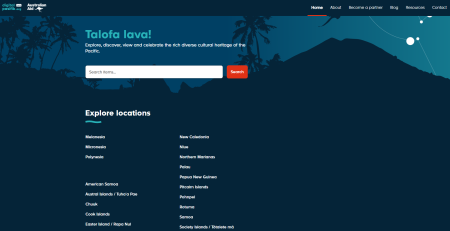
- ‘Pacific Virtual Museum’ Pilot Program, supported by the Australian Government and implemented by the National Library of New Zealand | Te Puna Mātauranga o Aotearoa in collaboration with the National Library of Australia
2019
Together with the Australian Government and National Library of Australia we are working with colleagues from across the Pacific to develop a shared online place that enables Pacific peoples to connect with their cultural heritage from around the world.
Avaiable in
- English
SDGs LINKAGES
The resource is closely linked to SDGs 1.4 (using and accessing collections), 4.5 (removing barriers in education), 4.7 (Education for Sustainable Development), 10.2 and 10.7 (reducing inequality), 11.4 (strengthening efforts to protect and safeguard cultural and natural heritage), and 17.9 (North-South, South-South co-operations and partnerships) as well as diversity of stakeholders (17.16).
Click on the SDG Target to discover Our Collections Matter indicators
-
Our Collections Matter indicators:
- Numbers and proportions of people from particular groups using collections in comparison with demographics in broader society.
- Numbers of people accessing collections.
- Number of targeted programmes that aim to enhance access to collections by disadvantaged groups.
- Sustainable tourism that enhances local communities’ access to basic services, ownership and control over land and other forms of property (including cultural and natural heritage), as well as to technology and markets.
- Involvement of people from disadvantaged groups in decision-making activities and processes relating to collections and collections-based institutions.
-

Our Collections Matter indicators:
- Number of educational and/or training programmes drawing on collections directed to eliminate gender disparities in education.
- Number of educational and/or training programmes drawing on collections directed to meet the particular needs of persons with disabilities.
- Number of educational and/or training programmes drawing on collections directed to meet the particular needs of Indigenous peoples’ groups.
- Number of educational and/or training programmes drawing on collections directed to meet the particular needs of children in vulnerable situations.
-
Our Collections Matter indicators:
- Numbers of people in each type of programme drawing on collections from different demographic groups.
- Increases in numbers of people in each type of programme from different demographic groups.
- Proportion of people involved in such programmes in relation to overall audience size.
- Evidence that learners have acquired knowledge and skills to promote sustainable development.
-
Our Collections Matter indicators:
- Collections development to ensure that collections effectively meet the needs of all, irrespective of age, sex, disability, race, ethnicity, origin, religion or economic or other status.
- Number and proportion of educational and participatory programmes that promote participation irrespective of social or other status.
- Numbers and proportions of people making use of collections in relation to the demographic of the local population.
- Numbers and proportions of people involved in focused programmes aimed at promoting social, economic and political inclusion.
- Numbers and proportions of people from different demographic groups involved in decision-making processes relating to collections and collections-based institutions.
- Number and types of partnerships that build relationships with marginalized groups, individuals and communities.
-
Our Collections Matter indicators:
- Collections development that supports a variety of uses relating to migration and that enables migrants and refugees to access their heritage.
- Numbers and proportions of people making use of collections who are from migrant backgrounds.
- Numbers and proportions of people involved in focused programmes supporting migrants and refugees.
- Use of collections for a variety of purposes (education, awareness-raising, research, partnerships) that address issues relating to migration, mobility, and refugees.
- Numbers and proportions of people and groups from different migrant backgrounds in decision-making processes relating to collections and collections-based institutions.
-

Our Collections Matter indicators:
- Total expenditure (public and private) per capita spent on the preservation, protection and conservation of all cultural and natural heritage, by type of heritage.
- Plans, policies and procedures in place for the safe use of collections for a variety of purposes, protecting and safeguarding both collections and those who use them.
- Plans, policies and procedures in place for the identification, safeguarding and protection of cultural and natural heritage at risk.
- Collecting programmes in place to protect, safeguard and make use of cultural and natural heritage, addressing the needs of communities and stakeholders, and ensuring that collections can be an effective resource for sustainable development.
- Number and diversity of educational, awareness-raising, research programmes, and partnerships that aim to strengthen protection of cultural and natural heritage.
-
Our Collections Matter indicators:
- Number and diversity of international capacity-building activities to aid implementation of each and all of the SDGs.
- Number and diversity of North-South, South-South, and/or triangular co-operations and partnerships to aid implementation of each and all of the SDGs.
-

Our Collections Matter indicators:
- Number and/or increase in number, and diversity of global and international multi-stakeholder partnerships that share collection-related knowledge, expertise, technology and financial resources to address the SDGs, or that otherwise involve collections-based organisations and institutions.
- Number and/or increase in number, and diversity of global and international multi-stakeholder partnerships involving developing countries that share collection-related knowledge, expertise, technology and financial resources to address the SDGs.