
ACTIONS
- Protect and safeguard cultural and natural heritage
- Learning and educational opportunities
- Cultural participation/social inclusion
- Sustainable tourism
- Support research
- Employment (recruiting, training, safety)
- Energy consumption, greenhouse gas emissions
- Waste management and reduction
- Transport (forms of, energy use)
- Commercial activities including copyright and IP
- Governance and management
- Security, disaster preparedness, risk reduction
- External partnerships and collaborations
SDGs



- Publication/report
- Toolkit/framework/roadmap
- Policy guidance
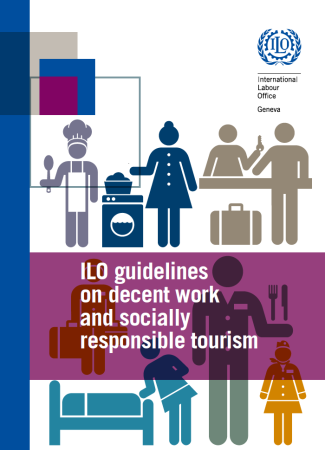
ILO Guidelines on Decent Work and Socially Responsible Tourism
Intended Audience
“The guidelines are intended for use by those engaged in developing and implementing policies and interventions in the tourism sector at international, national, regional, local and enterprise level, and
include, inter alia:
(a) government authorities at all levels;
(b) employers in the tourism sector and organizations representing them;
(c) workers in the tourism sector and organizations representing them;
(d) cooperatives, organizations of rural, local and ethnic communities and indigenous and tribal peoples engaged in the tourism sector;
(e) education and training institutions for tourism personnel;
(f) IGOs, NGOs and research institutions involved in the tourism sector.”
- International Labour Organization (ILO)
“Tourism is an important driving force for inclusive socio-economic development, with significant potential to stimulate enterprise and job creation, particularly for women and young people. It has experienced continued expansion and diversification over the last decades and is one of the most dynamic and fastest-growing economic sectors today. In spite of this, its role in employment generation and enterprise development is often overlooked in tourism development policies and strategies. Moreover, the tourism industry continues to face decent work challenges that need to be addressed in order to take full advantage of its potential for economic development and job creation…” (p.iv)
“These guidelines set out common principles and the policy framework that should guide action to achieve decent work and socially responsible tourism, and full and productive employment in the tourism industry, thereby promoting its sustainability, and contributing to the achievement of the SDGs. They should serve as a reference tool for the ILO constituents and other tourism stakeholders in their efforts to address labour-related challenges and opportunities for the sustainable development of the tourism sector.” (p.5)
Avaiable in
- English
- French
- Spanish
SDGs LINKAGES
The resource can help support action for SDG targets relating to sustainable tourism (8.9), measuring and monitoring sustainable tourism (12.B) and enhancing benefits from sustainable tourism in Developing countries (14.7). More broadly, the resource can contribute towards 4.3 (training opportunities), 4.4 (staff skills), 4.5 (access to education and training for all), 8.3 (job creation and encouraging small businesses), 8.5 (ensuring people have employment and decent work), 8.6 (reducing youth unemployment), 8.7 (prevent exploitation, including modern slavery), 8.8 (protect workers’ rights and provide secure working conditions), 8.9 (responsible tourism), 10.2 (universal inclusion), 10.3 (reduce inequalities of outcome), 10.4 (social protection), 12.6 (adopting sustainable practices), 12.7 (sustainable procurement), 16.6 (effective, accountable transparent institutions), 16.10 (protecting fundamental freedoms, including workers’ rights), 16.B (promote laws and policies for sustainable development), 17.14 (policy coherence) and 17.17 (local partnerships). Different aspects of the resource support additional SDG targets.
Click on the SDG Target to discover Our Collections Matter indicators
-
Our Collections Matter indicators:
- Number of learning programmes in schools, colleges and universities that make use of collections.
- Proportion of learning programmes in schools and colleges making use of collections that prioritise disadvantaged areas.
- Gender balance of students in learning programmes.
- Number of programmes using collections that aim to encourage people to participate in education in schools, colleges and universities.
-
Our Collections Matter indicators:
- Number of young people and adults in skills-development activities and programmes drawing on collections, for employment, decent jobs and entrepreneurship.
- Increase in number of young people and adults in such programmes.
- Number and proportion of staff who have received training in the last year, to better support their contribution to the SDGs.
- Programs and processes in place to ensure the availability of a skilled workforce.
-

Our Collections Matter indicators:
- Number of educational and/or training programmes drawing on collections directed to eliminate gender disparities in education.
- Number of educational and/or training programmes drawing on collections directed to meet the particular needs of persons with disabilities.
- Number of educational and/or training programmes drawing on collections directed to meet the particular needs of Indigenous peoples’ groups.
- Number of educational and/or training programmes drawing on collections directed to meet the particular needs of children in vulnerable situations.
-

Our Collections Matter indicators:
- Development-oriented policies in place for the range of activities, or development-oriented considerations are included in other policies.
- Number of micro-, small- and medium-sized enterprises supported.
- Number and proportion of formalised arrangements with micro-, small- and medium-sized enterprises.
- Total value of financial services or financial support provided to micro-, small and medium-sized enterprises.
-
Our Collections Matter indicators:
- Increase in number of people in full and productive employment relating to collections, through job creation and recruitment.
- Increase in proportion of existing staff working with collections in productive employment.
- Increase in number of men, women, young people and persons with disabilities in development and training programmes drawing on collections that support them in employment.
- Removal of pay disparities by gender and/or other status for those working with collections.
- Policies and plans in place to ensure that all suppliers and others in the supply chain are in decent and productive work.
-
Our Collections Matter indicators:
- Number of young people in employment, education or training relating to collections.
- Number of people in dedicated programmes relating to collections, who would otherwise not be in employment, education or training.
-
Our Collections Matter indicators:
- Policies and plans in place to ensure that forced labour, modern slavery, human trafficking and child labour are completely eliminated from throughout the supply chain.
- Number of collections development, educational and awareness-raising, and research programmes and partnerships aimed at eradicating forced labour, modern slavery and human trafficking.
-
Our Collections Matter indicators:
- Number and proportions of staff working with collections in safe and secure working environments.
- Number of accidents and other health and safety incidents reported.
- Training and support provided for staff to ensure their wellbeing, health and safety.
- Education, awareness-raising and partnership programmes drawing on collections that address labour rights, notably those of migrant workers and others in precarious employment.
- Reduction of numbers and proportions of staff on short-term or zero-hours contracts.
- Fair pay policies and procedures in place to prevent exploitation.
- Procurement policies that ensure that collecting institutions make use of people who are in decent employment, and that avoid exploitation throughout the supply chain.
-
Our Collections Matter indicators:
- Numbers of jobs created or supported that relate to sustainable tourism drawing on local products (e.g. craft producers).
- Develop and implement plans to reduce and remove negative impacts of tourism.
- Numbers of activities and/or products drawing on local culture.
- Value to artisans and source communities of activities and products drawing on local culture.
-
Our Collections Matter indicators:
- Collections development to ensure that collections effectively meet the needs of all, irrespective of age, sex, disability, race, ethnicity, origin, religion or economic or other status.
- Number and proportion of educational and participatory programmes that promote participation irrespective of social or other status.
- Numbers and proportions of people making use of collections in relation to the demographic of the local population.
- Numbers and proportions of people involved in focused programmes aimed at promoting social, economic and political inclusion.
- Numbers and proportions of people from different demographic groups involved in decision-making processes relating to collections and collections-based institutions.
- Number and types of partnerships that build relationships with marginalized groups, individuals and communities.
-

Our Collections Matter indicators:
- Identification of discriminatory policies and practices, with clear plans to address these, to ensure equal opportunity for all and reduce inequalities of outcome.
- Collections development to uphold and promote legislation and anti-discriminatory perspectives, with the aim of reducing inequality within and between countries.
- Education and participatory programmes that promote anti-discriminatory legislation, policies and action, with the aim of reducing inequality within and between countries.
- Research that supports anti-discriminatory legislation, policies and action, with the aim of reducing inequality within and between countries.
- Participation in partnerships that promote anti-discriminatory legislation, policies and action, with the aim of reducing inequality within and between countries.
-
Our Collections Matter indicators:
- Number and proportion of policies that proactively address equality issues relating to fiscal, wage and social protection considerations.
-
Our Collections Matter indicators:
- Clear visions, strategies and plans in place for all aspects of sustainability – environmental, social and economic (people, planet, prosperity)- across all areas of activity.
- Visions, strategies and plans relating to sustainability to be publicly available and incorporated into planning documents.
- Commitments to be in line with local, regional, national and/or international targets and ambitions.
- Incorporation of sustainability into reporting for funders and other stakeholders, including the public. Reporting to include commitments and progress towards targets.
-
Our Collections Matter indicators:
- Incorporation of sustainability considerations into procurement, in terms of advertisement and invitation to tender, contracts, and selection criteria for suppliers.
-
Our Collections Matter indicators:
- Quantitative and qualitative metrics identified, collected and reported for evaluating performance of tourism in terms of social, environmental and economic benefits and impacts for:
-jobs
-promotion of local culture
-local and related products
-positive social and environmental benefits
-reduction of negative impacts of tourism, e.g. climate impacts, negative social and environmental impacts.
- Quantitative and qualitative metrics identified, collected and reported for evaluating performance of tourism in terms of social, environmental and economic benefits and impacts for:
-
Our Collections Matter indicators:
- Number of activities that support sustainable tourism relating to Small Island developing States and least developed countries.
- Economic benefits by value to Small Island Developing States and least developed countries.
-
Our Collections Matter indicators:
- Proportion of the population [audience/users/non-users] satisfied with their last experience of public services.
- Access to information, and accountability policies and mechanisms, in place.
- Effective institutional arrangements, both for own working and for working in partnership with other sectors, in place.
- Plans and arrangements in place for extraordinary circumstances such as natural and human-caused disasters.
- Effective arrangements in place to fulfil legal and social obligations and responsibilities.
- Effective arrangements in place for transparent communication and reporting of institutional performance.
- Effective arrangements in place for transparent decision-making and accountability.
-
Our Collections Matter indicators:
- Adopt and implement constitutional, statutory and/or policy guarantees for public access to information.
- Plans in place, and plans implemented to enhance public access to information relating to collections.
- Plans in place, and plans implemented to support fundamental freedoms, in line with human rights, national and international agreements and legislation.
- Plans and procedures in place for public access to information relating to the operation and management of collections-based institutions.
- Complaint mechanism in place for public to use where public access to information and fundamental freedoms not supported or fulfilled.
-
Our Collections Matter indicators:
- Proportion of population [audience/users/non-users] reporting having personally felt discriminated against or harassed in the previous 12 months on the basis of a ground of discrimination prohibited under international human rights law.
- Number and proportion of policies that incorporate sustainable development considerations, in the full sense of recognizing all three of social, economic and environmental considerations.
-
Our Collections Matter indicators:
- Proportion of policies that incorporate sustainable development considerations, linking to SDGs and targets.
- Incorporation of policy considerations from outside the collections sector into policies of collections-based institutions, to facilitate partnerships and effectiveness.
-

Our Collections Matter indicators:
- Amount of United States dollars committed to public-private and civil society partnerships.
- Number and/or increase in number, and diversity of local, national and regional multi-stakeholder (public, public-private and civil society) partnerships that address the SDGs drawing on collections, or that otherwise involve collections-based organisations and institutions.