
ACTIONS
- Protect and safeguard cultural and natural heritage
- Learning and educational opportunities
- Cultural participation/social inclusion
- Sustainable tourism
- Support research
- Employment (recruiting, training, safety)
- Energy consumption, greenhouse gas emissions
- Waste management and reduction
- Transport (forms of, energy use)
- Commercial activities including copyright and IP
- Governance and management
- Security, disaster preparedness, risk reduction
- External partnerships and collaborations
SDGs



- Toolkit/framework/roadmap
- Case studies
IISD Real People Real Change: Just Transition Examples from Around the World
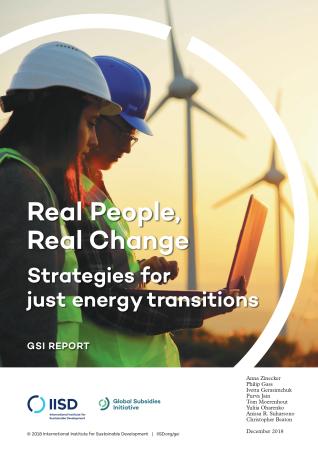
- A. Zinecker and others, IISD
“Energy transitions can seem daunting, making it difficult to act early. This report aims to support governments of both developed and developing countries in their endeavour to make energy transitions just. It brings together political and communications strategies for a just transition, building on research and case studies of energy transitions that have happened or that are happening in Canada, Egypt, Indonesia, India, Poland and Ukraine.” (p.3)
Avaiable in
- English
SDGs LINKAGES
The resource can help support action for SDG targets relating to education, skills development and work related to climate change, including 1.5 (build the resilience of the poor), 4.3 (education for work), 4.4 (staff skills), 4.5 (educational opportunities for all), 4.7 (Education for Sustainable Development), 7.2 (increase use of clean energy, 8.3 (policies for job creation and decent work), 8.4 (circular economy), 8.5 (ensuring people have employment and decent work), 8.6 (reduce youth unemployment), 8.8 (protect workers’ rights and provide secure working conditions), 9.4 (retrofit industries), 10.2 (universal inclusion), 10.4 (social protection), 11.3 (inclusive decision making on urban development, which may include major industry shifts), 11.5 (reduce disaster risk), 11.B (integrated policies, including for social inclusion, climate action and resource use), 12.6 (adopting sustainable practices), 12.8 (information for sustainable development and lifestyles in harmony with nature), 13.1 (climate adaptation), 13.2 (national climate planning), 13.3 (education and awareness for climate mitigation, adaptation and risk reduction), 13.B (climate action in Global South countries), 16.7 (participatory decision making), 16.10 (protecting fundamental freedoms, including workers’ rights), 16.B (promote laws and policies for sustainable development), 17.14 (policy coherence), 17.17 (cross-sector partnerships).
Click on the SDG Target to discover Our Collections Matter indicators
-
Our Collections Matter indicators:
- Number of collecting programmes that aim to build resilience to climate-related events and other shocks and disasters, for example by forming collections that can contribute to related educational and research programmes.
- Number of educational programmes drawing on collections that incorporate resilience perspectives.
- Number of targeted programmes drawing on collections that are aimed at vulnerable groups, to build their resilience to climate-related and other shocks and disasters.
- Number of research programmes drawing on collections that are aimed at building resilience to climate-related and other shocks and disasters.
- Strengthen the resilience of employees, communities and suppliers by paying at a minimum the living wage and offering insurance to employees and their families, such as accident insurance; and by paying fair prices to all suppliers.
-
Our Collections Matter indicators:
- Number of learning programmes in schools, colleges and universities that make use of collections.
- Proportion of learning programmes in schools and colleges making use of collections that prioritise disadvantaged areas.
- Gender balance of students in learning programmes.
- Number of programmes using collections that aim to encourage people to participate in education in schools, colleges and universities.
-
Our Collections Matter indicators:
- Number of young people and adults in skills-development activities and programmes drawing on collections, for employment, decent jobs and entrepreneurship.
- Increase in number of young people and adults in such programmes.
- Number and proportion of staff who have received training in the last year, to better support their contribution to the SDGs.
- Programs and processes in place to ensure the availability of a skilled workforce.
-

Our Collections Matter indicators:
- Number of educational and/or training programmes drawing on collections directed to eliminate gender disparities in education.
- Number of educational and/or training programmes drawing on collections directed to meet the particular needs of persons with disabilities.
- Number of educational and/or training programmes drawing on collections directed to meet the particular needs of Indigenous peoples’ groups.
- Number of educational and/or training programmes drawing on collections directed to meet the particular needs of children in vulnerable situations.
-
Our Collections Matter indicators:
- Numbers of people in each type of programme drawing on collections from different demographic groups.
- Increases in numbers of people in each type of programme from different demographic groups.
- Proportion of people involved in such programmes in relation to overall audience size.
- Evidence that learners have acquired knowledge and skills to promote sustainable development.
-
Our Collections Matter indicators:
- Number and proportion of policies relating to collections and collections-based institutions that incorporate gender perspectives to promote gender equality and empowerment of all women and girls at all levels.
-
Our Collections Matter indicators:
- Proportion of energy that comes from renewable sources.
- Date to achieve net zero, and milestones towards that date.
-

Our Collections Matter indicators:
- Development-oriented policies in place for the range of activities, or development-oriented considerations are included in other policies.
- Number of micro-, small- and medium-sized enterprises supported.
- Number and proportion of formalised arrangements with micro-, small- and medium-sized enterprises.
- Total value of financial services or financial support provided to micro-, small and medium-sized enterprises.
-
Our Collections Matter indicators:
- Plans in place to increase resource efficiency, reduce consumption, and to decouple economic growth from environmental degradation.
-
Our Collections Matter indicators:
- Increase in number of people in full and productive employment relating to collections, through job creation and recruitment.
- Increase in proportion of existing staff working with collections in productive employment.
- Increase in number of men, women, young people and persons with disabilities in development and training programmes drawing on collections that support them in employment.
- Removal of pay disparities by gender and/or other status for those working with collections.
- Policies and plans in place to ensure that all suppliers and others in the supply chain are in decent and productive work.
-
Our Collections Matter indicators:
- Number of young people in employment, education or training relating to collections.
- Number of people in dedicated programmes relating to collections, who would otherwise not be in employment, education or training.
-
Our Collections Matter indicators:
- Number and proportions of staff working with collections in safe and secure working environments.
- Number of accidents and other health and safety incidents reported.
- Training and support provided for staff to ensure their wellbeing, health and safety.
- Education, awareness-raising and partnership programmes drawing on collections that address labour rights, notably those of migrant workers and others in precarious employment.
- Reduction of numbers and proportions of staff on short-term or zero-hours contracts.
- Fair pay policies and procedures in place to prevent exploitation.
- Procurement policies that ensure that collecting institutions make use of people who are in decent employment, and that avoid exploitation throughout the supply chain.
-
Our Collections Matter indicators:
- Collections development to ensure that collections effectively meet the needs of all, irrespective of age, sex, disability, race, ethnicity, origin, religion or economic or other status.
- Number and proportion of educational and participatory programmes that promote participation irrespective of social or other status.
- Numbers and proportions of people making use of collections in relation to the demographic of the local population.
- Numbers and proportions of people involved in focused programmes aimed at promoting social, economic and political inclusion.
- Numbers and proportions of people from different demographic groups involved in decision-making processes relating to collections and collections-based institutions.
- Number and types of partnerships that build relationships with marginalized groups, individuals and communities.
-
Our Collections Matter indicators:
- Number and proportion of policies that proactively address equality issues relating to fiscal, wage and social protection considerations.
-
Our Collections Matter indicators:
- Proportion of cities with a direct participation structure of civil society in urban planning and management that operate regularly and democratically.
- Plans in place for collections-based institutions to facilitate the incorporation of communities’ views into local planning and town management processes in a regular way.
- Plans in place for collections-based institutions to facilitate the incorporation of minorities’ views into local planning and town management processes in a regular way.
-
Our Collections Matter indicators:
- Collections-based research that supports the understanding and management of disasters of all kinds.
- Plans in place for public education and awareness drawing on collections and collections-based institutions to reduce exposure and vulnerability to disasters of all kinds.
- Plans in place to ensure collections-based institutions steadily work to reduce their contributions to disaster risk, for example by reducing pollution and waste of all kinds.
- Plans in place to ensure collections-based institutions, and people related to them (including workers) are protected from economic losses as a result of disasters.
- Plans in place to provide special support/protection to poor and vulnerable people and groups in and following disasters.
-
Our Collections Matter indicators:
- Proportion of local governments that adopt and implement local disaster risk reduction strategies in line with the Sendai Framework for Disaster Risk Reduction 2015-2030a.
- Disaster Risk Reduction strategies and plans in place, in line with the Sendai Framework for Disaster Risk Reduction, to ensure collecting institutions and collections are factored into planning, and contribute effectively to Disaster Risk Reduction.
- Collections-based institutions included in local plans for social inclusion, resource use, and Disaster Risk Reduction.
-
Our Collections Matter indicators:
- Clear visions, strategies and plans in place for all aspects of sustainability – environmental, social and economic (people, planet, prosperity)- across all areas of activity.
- Visions, strategies and plans relating to sustainability to be publicly available and incorporated into planning documents.
- Commitments to be in line with local, regional, national and/or international targets and ambitions.
- Incorporation of sustainability into reporting for funders and other stakeholders, including the public. Reporting to include commitments and progress towards targets.
-
Our Collections Matter indicators:
- Extent to which (i) global citizenship education and (ii) education for sustainable development (including climate change education) are mainstreamed in (a) national education policies; (b) curricula; (c) teacher education; and (d) student assessment.
- Extent to which global citizenship education and education for sustainable development (including climate change education) are mainstreamed in formal, informal and non-formal education programmes and activities drawing on and related to collections.
-
Our Collections Matter indicators:
- Plans in place for near and longer term to withstand and actively adapt to climate-related hazards and natural disasters.
-
Our Collections Matter indicators:
- National organisations, institutions and networks relating to collections and collections-based institutions to have integrated climate change measures into policies, strategies and planning relating to collections and collections-based institutions, including funding and other resourcing considerations.
-
Our Collections Matter indicators:
- Plans in place to enhance positive contributions to addressing climate change through use of collections. Plans in place to ensure collections, collections institutions and broader society can adapt effectively to climate change.
- Plans in place for effective education and awareness raising on climate change mitigation, adaptation, impact reduction and early warning.
- Plans in place to reduce negative contributions of collections-related functions, e.g. measuring greenhouse emissions with plans and targets in place to reduce them.
-
Our Collections Matter indicators:
- Number of initiatives (educational, awareness-raising, research, and/or partnerships) drawing on collections and collections-based institutions that build capacity for climate change planning and management in least developed countries and small island developing States.
- Number of targeted initiatives drawing on collections and collections-based institutions aimed at building capacity for women, youth and local and marginalized communities in least developed countries and small island developing States.
-

Our Collections Matter indicators:
- Proportions of positions (by sex, age, persons with disabilities and population groups) in public institutions (national and local legislatures, public service, and judiciary) compared to national distributions.
- Proportion of population [audience/users/non-users] who believe decision-making is inclusive and responsive, by sex, age, disability and population group.
- Decision-making addresses societal, environmental and economic challenges related to the community, considering short-term and long-term risks and opportunities.
- Decision-making draws on diverse backgrounds, viewpoints and interests, reflecting a broad base of stakeholders, and working to promote inclusion and provide effective services for all of society.
-
Our Collections Matter indicators:
- Adopt and implement constitutional, statutory and/or policy guarantees for public access to information.
- Plans in place, and plans implemented to enhance public access to information relating to collections.
- Plans in place, and plans implemented to support fundamental freedoms, in line with human rights, national and international agreements and legislation.
- Plans and procedures in place for public access to information relating to the operation and management of collections-based institutions.
- Complaint mechanism in place for public to use where public access to information and fundamental freedoms not supported or fulfilled.
-
Our Collections Matter indicators:
- Proportion of population [audience/users/non-users] reporting having personally felt discriminated against or harassed in the previous 12 months on the basis of a ground of discrimination prohibited under international human rights law.
- Number and proportion of policies that incorporate sustainable development considerations, in the full sense of recognizing all three of social, economic and environmental considerations.
-
Our Collections Matter indicators:
- Proportion of policies that incorporate sustainable development considerations, linking to SDGs and targets.
- Incorporation of policy considerations from outside the collections sector into policies of collections-based institutions, to facilitate partnerships and effectiveness.
-
Our Collections Matter indicators:
- Amount of United States dollars committed to public-private and civil society partnerships.
- Number and/or increase in number, and diversity of local, national and regional multi-stakeholder (public, public-private and civil society) partnerships that address the SDGs drawing on collections, or that otherwise involve collections-based organisations and institutions.