ACTIONS
- Protect and safeguard cultural and natural heritage
- Learning and educational opportunities
- Cultural participation/social inclusion
- Sustainable tourism
- Support research
- Employment (recruiting, training, safety)
- Energy consumption, greenhouse gas emissions
- Waste management and reduction
- Transport (forms of, energy use)
- Commercial activities including copyright and IP
- Governance and management
- Security, disaster preparedness, risk reduction
- External partnerships and collaborations
- Publication/report
- Toolkit/framework/roadmap
- Case studies
- Evaluation framework
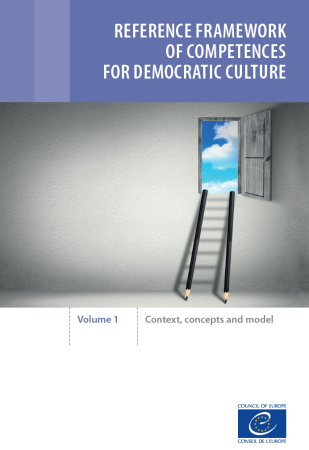
Competences for Democratic Culture
Intended Audience
Educators of all kinds, also applicable to staff skills and training
- Council of Europe
“This document describes a conceptual model of the competences which need to be acquired by learners if they are to participate effectively in a culture of democracy and live peacefully together with others in culturally diverse democratic societies. It is intended that the model will be used to inform educational decision making and planning, helping educational systems to be harnessed for the preparation of learners for life as competent democratic citizens.”
Avaiable in
- Albanian
- Armenian
- Azeri
- English
- Finnish
- French
- Georgian
- German
- Greek
- Macedonian
- Romanian
- Serbian
- Spanish
- Turkish
- Ukrainian
SDGs LINKAGES
The resource is most closely related to SDGs around training of educators, and education, including 4.4 (staff training), 4.7 (Education for Sustainable Development), 16.10 (fundamental freedoms) and 16.B (promote laws and policies for sustainable development).
Click on the SDG Target to discover Our Collections Matter indicators
-
Our Collections Matter indicators:
- Number of young people and adults in skills-development activities and programmes drawing on collections, for employment, decent jobs and entrepreneurship.
- Increase in number of young people and adults in such programmes.
- Number and proportion of staff who have received training in the last year, to better support their contribution to the SDGs.
- Programs and processes in place to ensure the availability of a skilled workforce.
-
Our Collections Matter indicators:
- Numbers of people in each type of programme drawing on collections from different demographic groups.
- Increases in numbers of people in each type of programme from different demographic groups.
- Proportion of people involved in such programmes in relation to overall audience size.
- Evidence that learners have acquired knowledge and skills to promote sustainable development.
-
Our Collections Matter indicators:
- Adopt and implement constitutional, statutory and/or policy guarantees for public access to information.
- Plans in place, and plans implemented to enhance public access to information relating to collections.
- Plans in place, and plans implemented to support fundamental freedoms, in line with human rights, national and international agreements and legislation.
- Plans and procedures in place for public access to information relating to the operation and management of collections-based institutions.
- Complaint mechanism in place for public to use where public access to information and fundamental freedoms not supported or fulfilled.
-
Our Collections Matter indicators:
- Proportion of population [audience/users/non-users] reporting having personally felt discriminated against or harassed in the previous 12 months on the basis of a ground of discrimination prohibited under international human rights law.
- Number and proportion of policies that incorporate sustainable development considerations, in the full sense of recognizing all three of social, economic and environmental considerations.