ACTIONS
- Protect and safeguard cultural and natural heritage
- Learning and educational opportunities
- Cultural participation/social inclusion
- Sustainable tourism
- Support research
- Employment (recruiting, training, safety)
- Energy consumption, greenhouse gas emissions
- Waste management and reduction
- Transport (forms of, energy use)
- Commercial activities including copyright and IP
- Governance and management
- Security, disaster preparedness, risk reduction
- External partnerships and collaborations
- Toolkit/framework/roadmap
- Case studies
Arts in Mind: A Multidisciplinary Approach to Museum Programs for Persons Living with Young-Onset and Early-Stage Alzheimer’s Disease
Intended Audience
Those working with museums and art therapy-based programmes.
- R.Thompson, A. Duncan and J. Slack, International Journal of Lifelong Learning in Art Education
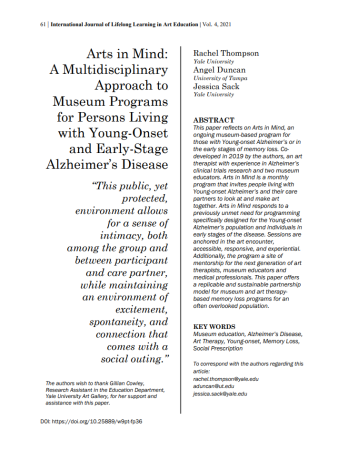
“This paper reflects on Arts in Mind, an ongoing museum-based program for those with Young-onset Alzheimer’s or in the early stages of memory loss. Codeveloped in 2019 by the authors, an art therapist with experience in Alzheimer’s clinical trials research and two museum educators. Arts in Mind is a monthly program that invites people living with Young-onset Alzheimer’s and their care partners to look at and make art together. Arts in Mind responds to a previously unmet need for programming specifically designed for the Young-onset Alzheimer’s population and individuals in early stages of the disease. Sessions are anchored in the art encounter, accessible, responsive, and experiential.
Additionally, the program [was?] a site of mentorship for the next generation of art therapists, museum educators and medical professionals. This paper offers a replicable and sustainable partnership model for museum and art therapy- based memory loss programs for an often overlooked population.” (Abstract)
Avaiable in
- English
SDGs LINKAGES
The resource supports a wide range of SDGs relating to inclusion, participation and access to services, including 1.4 (access to basic services), 3.4 (promoting mental health and wellbeing), 4.5 (removing barriers to all levels of education), 4.A (effective learning environments), 10.2 (universal inclusion), 10.3 (reducing inequality of outcomes), 11.7 (safe and welcoming green and public spaces), 11.B (integrated planning) and 17.17 (cross-sector partnerships).
Click on the SDG Target to discover Our Collections Matter indicators
-
Our Collections Matter indicators:
- Numbers and proportions of people from particular groups using collections in comparison with demographics in broader society.
- Numbers of people accessing collections.
- Number of targeted programmes that aim to enhance access to collections by disadvantaged groups.
- Sustainable tourism that enhances local communities’ access to basic services, ownership and control over land and other forms of property (including cultural and natural heritage), as well as to technology and markets.
- Involvement of people from disadvantaged groups in decision-making activities and processes relating to collections and collections-based institutions.
-
Our Collections Matter indicators:
- Plans, policies and procedures in place for the safe use of collections, notably in relation to chemical, physical, biological and other forms of hazard.
- Proportion of users of collections facilities reporting positive well-being during and as a result of activities relating to collections.
- Number and proportion of programmes relating to collections that incorporate wellbeing considerations and perspectives.
- Number of targeted programmes drawing on collections that address issues relating to non-communicable diseases, supporting prevention and treatment.
-
Our Collections Matter indicators:
- Number of educational and/or training programmes drawing on collections directed to eliminate gender disparities in education.
- Number of educational and/or training programmes drawing on collections directed to meet the particular needs of persons with disabilities.
- Number of educational and/or training programmes drawing on collections directed to meet the particular needs of Indigenous peoples’ groups.
- Number of educational and/or training programmes drawing on collections directed to meet the particular needs of children in vulnerable situations.
-
Our Collections Matter indicators:
- Number and proportion of education facilities that are child, disability and gender sensitive.
- Proportion of education facilities that provide safe, non-violent, inclusive and effective learning environments for all.
- Number and type of initiatives to improve effectiveness of learning environments.
- Support given to other education facilities to make them more inclusive and effective.
-
Our Collections Matter indicators:
- Collections development to ensure that collections effectively meet the needs of all, irrespective of age, sex, disability, race, ethnicity, origin, religion or economic or other status.
- Number and proportion of educational and participatory programmes that promote participation irrespective of social or other status.
- Numbers and proportions of people making use of collections in relation to the demographic of the local population.
- Numbers and proportions of people involved in focused programmes aimed at promoting social, economic and political inclusion.
- Numbers and proportions of people from different demographic groups involved in decision-making processes relating to collections and collections-based institutions.
- Number and types of partnerships that build relationships with marginalized groups, individuals and communities.
-
Our Collections Matter indicators:
- Identification of discriminatory policies and practices, with clear plans to address these, to ensure equal opportunity for all and reduce inequalities of outcome.
- Collections development to uphold and promote legislation and anti-discriminatory perspectives, with the aim of reducing inequality within and between countries.
- Education and participatory programmes that promote anti-discriminatory legislation, policies and action, with the aim of reducing inequality within and between countries.
- Research that supports anti-discriminatory legislation, policies and action, with the aim of reducing inequality within and between countries.
- Participation in partnerships that promote anti-discriminatory legislation, policies and action, with the aim of reducing inequality within and between countries.
-
Our Collections Matter indicators:
- Numbers of people accessing collecting institutions from different demographic groups, notably women, children, older people and persons with disabilities.
- Increases in numbers of people accessing collecting institutions from different demographic groups.
- Measures taken to remove barriers to access green and public spaces.
- Extent of green space provided by collections institutions.
-
Our Collections Matter indicators:
- Proportion of local governments that adopt and implement local disaster risk reduction strategies in line with the Sendai Framework for Disaster Risk Reduction 2015-2030a.
- Disaster Risk Reduction strategies and plans in place, in line with the Sendai Framework for Disaster Risk Reduction, to ensure collecting institutions and collections are factored into planning, and contribute effectively to Disaster Risk Reduction.
- Collections-based institutions included in local plans for social inclusion, resource use, and Disaster Risk Reduction.
-
Our Collections Matter indicators:
- Amount of United States dollars committed to public-private and civil society partnerships.
- Number and/or increase in number, and diversity of local, national and regional multi-stakeholder (public, public-private and civil society) partnerships that address the SDGs drawing on collections, or that otherwise involve collections-based organisations and institutions.